

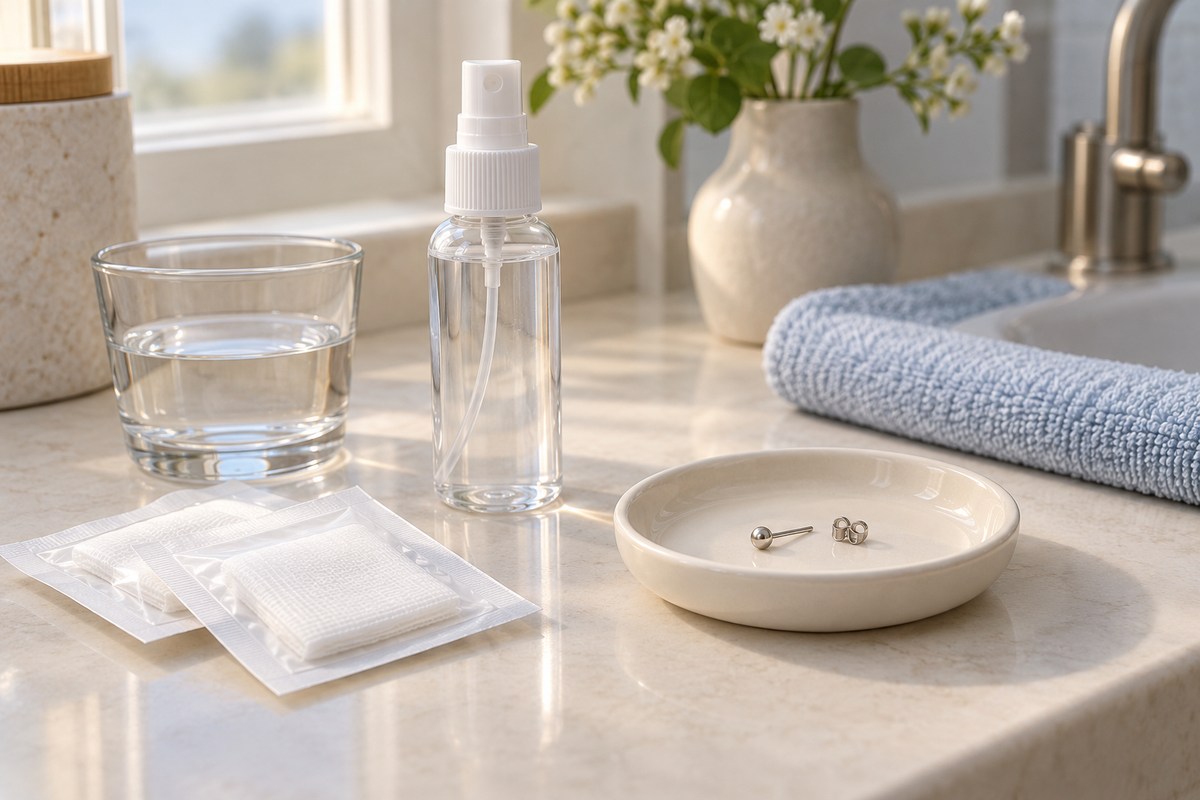
If you've noticed a little dried material around an ear piercing, don't start by scraping it off. Check how your ear feels, wash your hands, and keep the jewelry still. Cleaning a healing piercing doesn't require removing every visible speck at once.
“Crusties” is an informal name for dried material around the opening or jewelry. It describes what you can see, not the cause. This guide focuses on gentle cleaning and the point at which it makes sense to ask for help.
Check your ear before reaching for a cleanser
The Association of Professional Piercers explains that a healing piercing can produce whitish-yellow fluid that dries into crust on the jewelry. That can happen during healing, but the presence or absence of crust doesn't establish whether your piercing has healed.
Color alone can't tell you whether something is routine discharge, irritation or infection. Notice how your ear feels as well as what you can see. An ear that feels increasingly hot, swollen or painful needs more than a decision about which cleanser to use.
Follow NHS advice on infected piercings and seek prompt medical advice if you suspect infection, particularly with pus, significant heat, pain or swelling, or feeling hot, cold, shivery or generally unwell. Don't try to settle the question by cleaning harder. For a broader explanation of overlapping symptoms, see our piercing irritation guide.
Set out a few simple supplies
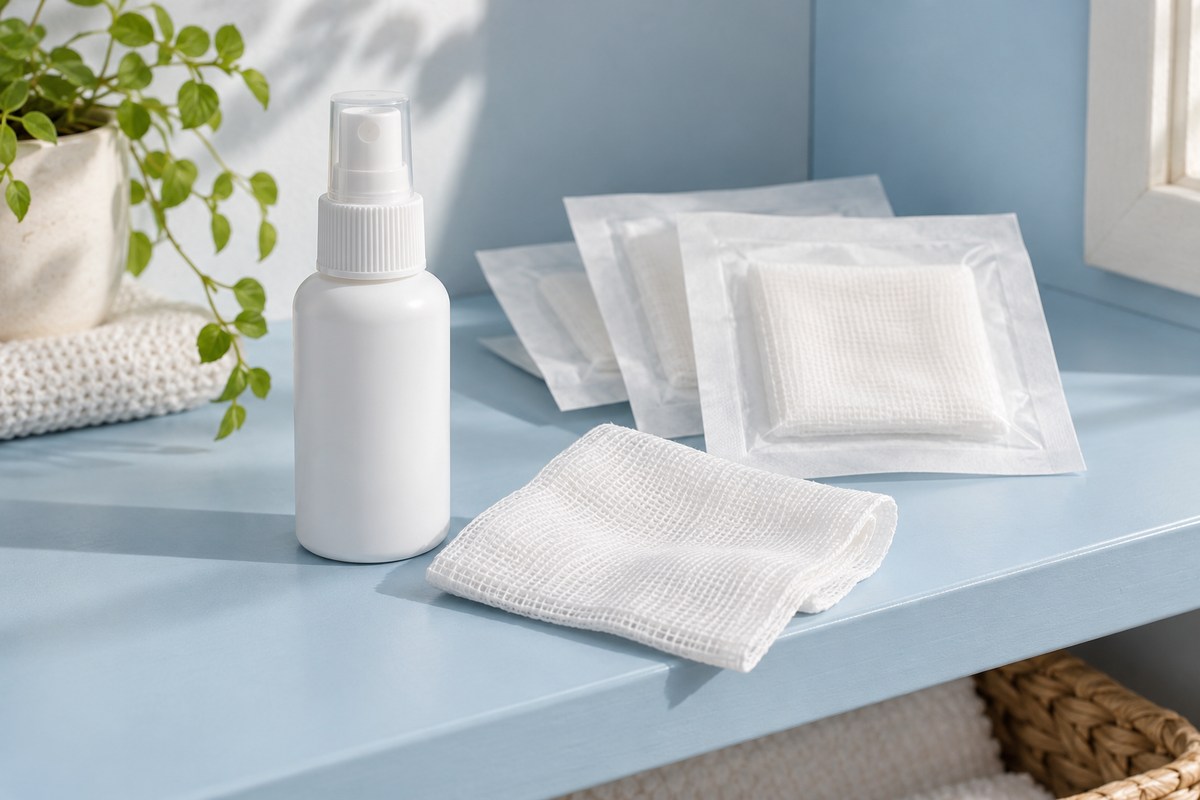
For routine cleaning, the APP recommends packaged sterile saline wound wash containing 0.9% sodium chloride without extra additives. Read the ingredients and the intended use on the container. A product with “saline” on the front isn't enough information on its own.
Have clean, disposable gauze or a clean paper product ready for drying. Wash your hands before you touch the area. Set things where you can reach them without having to search through a drawer midway through cleaning.
You don't need to assemble a collection of stronger products. The APP advises avoiding alcohol, hydrogen peroxide and other harsh cleaning products, as well as overcleaning. If you aren't sure whether the bottle you already own is appropriate, take its ingredient list to your piercer before using it.

Clean gently and leave attached crust alone
Apply the sterile saline wound wash to the piercing as directed on its label. Keep the jewelry in place while you clean. There's no need to turn the stud to work liquid into the opening, and the APP advises against rotating jewelry during healing.
Let softened, loose material come away with gentle rinsing. Don't use a fingernail to lift a dry edge, scrape along the post, or pull at a piece that is still attached. If it won't come away gently, leave it alone. You don't need to remove every speck in one cleaning session.
Dry the area gently with the clean disposable gauze or paper product you prepared. Avoid rubbing back and forth or dragging the material over the jewelry. Take care around the front and back without pulling the stud sideways to inspect underneath it.
If you can't reach a buildup without moving or tugging the jewelry, ask your piercer for help. Being able to see something behind a stud doesn't mean you need to get it off yourself. Have the piercing checked if cleaning has become painful or difficult.
Avoid turning each speck into another cleaning session
It's easy to keep returning to the mirror when an ear feels sensitive. Resist picking at a crust between cleanings or testing whether the stud will turn. Extra handling and overcleaning can irritate a healing piercing.
Use your piercer's individualized aftercare guidance rather than adding another rinse every time you notice residue. Recurring crust alone isn't a reason to add more cleaning or switch to a stronger product.
If the same area keeps feeling sore, describe what you've been doing when you contact your piercer. Mention the cleanser, how you dry the area, and whether you've been moving the jewelry. That gives them a clearer account of your routine. Worsening symptoms or suspected infection belong with a healthcare professional.
Once the piercing has fully healed
Save jewelry shopping for a fully healed piercing. Crust disappearing isn't clearance to change an earring, and a new stud isn't a way to treat discharge or soreness. Ask your piercer if you're unsure whether the piercing is ready for a change.
For later shopping, the Small Solitaire listing describes G23 titanium, an approximately 3 mm face and a flat-back post measuring 20G (0.8 mm) by 6 mm wearable length. It is sold as a pair. The Crystal Trio Bar listing describes F136/G23 titanium alloy, an approximately 5.3 by 2.1 mm front and a threadless push-pin flat back, also with a 20G post and 6 mm wearable length, sold as a pair.
These are listing descriptions, not independent material-certification checks. Check fit with your piercer before choosing either style for a healed piercing; neither is recommended here for a fresh piercing.
Questions about piercing crusties
Should I remove the earring to clean behind it?
Don't remove healing jewelry just to reach dried material. Ask your piercer to assess an awkward buildup. If you suspect infection, seek medical advice and leave the jewelry in unless a doctor tells you to remove it.
Can I tell whether cleaning worked by how clear the ear looks?
A perfectly clear surface isn't a useful target if reaching it means scraping or repeated handling. Gentle cleaning can leave attached material in place. Ask a professional about changes that concern you, even if the surface looks clean.
What should I tell a professional if crust keeps coming back?
Explain when you noticed it, whether pain, heat or swelling has changed, and which aftercare products you've used. Mention feeling feverish or unwell when seeking medical advice. Don't rely on a description of the crust's color alone.

Related posts
Ear Piercing Costs: What Your Quote Should Include
Compare ear-piercing quotes by the number of holes, complete jewelry, follow-up services and other charges, with specific official studio examples.
Surface Tragus vs Tragus: Why the Jewelry Is Different
Learn how surface bars, labret studs and surface anchors differ, and what to confirm before buying jewelry for a piercing beside the tragus.
Vertical Helix vs Hidden Helix: Check the Jewelry Direction
Compare vertical and hidden helix descriptions, check what product photographs leave out, and read jewelry specifications for a fully healed piercing.