

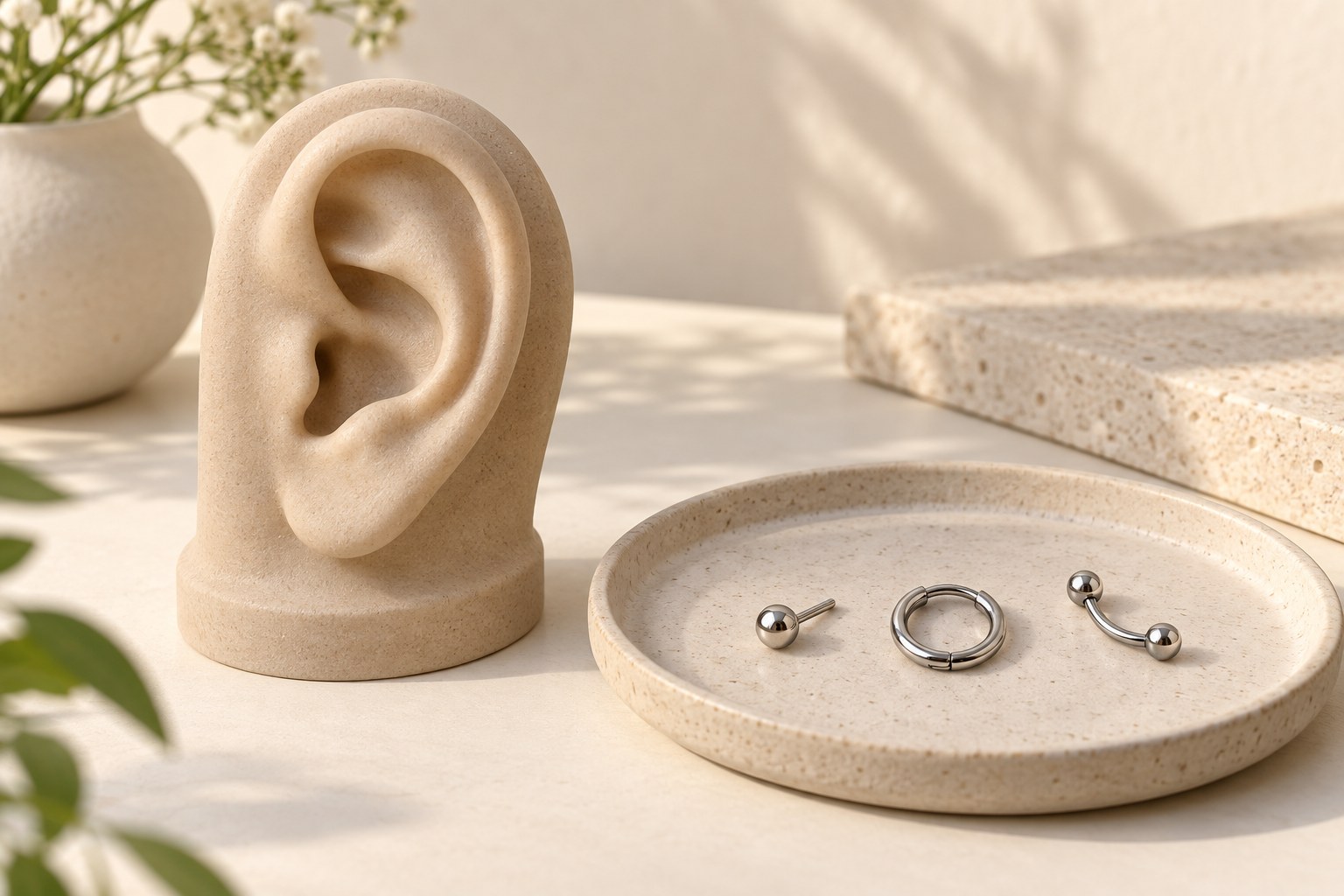
You see an earring you like, open the product menu, and meet a row of unfamiliar names: helix, flat, conch, tragus. An ear piercing chart can help you find the right part of the ear. The next step is checking whether the jewelry actually fits your piercing.
Use this guide to navigate styles for existing, fully healed piercings. It is not a placement plan for a new piercing, and a drawing cannot tell you which post length to buy.
Read the ear in regions
Start at the soft lower lobe and follow the outer rim upward. That rim is the helix. The broad upper surface just inside it is commonly called the flat. Move inward to the bowl-shaped area and you're looking at the conch.
Near the entrance to the ear canal, the small projecting flap is the tragus. The forward helix sits toward the front attachment of the outer rim. Farther inside, rook and daith piercings pass through different cartilage folds. Their names aren't interchangeable, even when a small photograph makes them look close together.
You don't need to memorize every name before shopping. Find the region that matches your existing piercing, then use the chart to choose the relevant guide. If you're unsure which channel you have, ask your piercer to identify it.
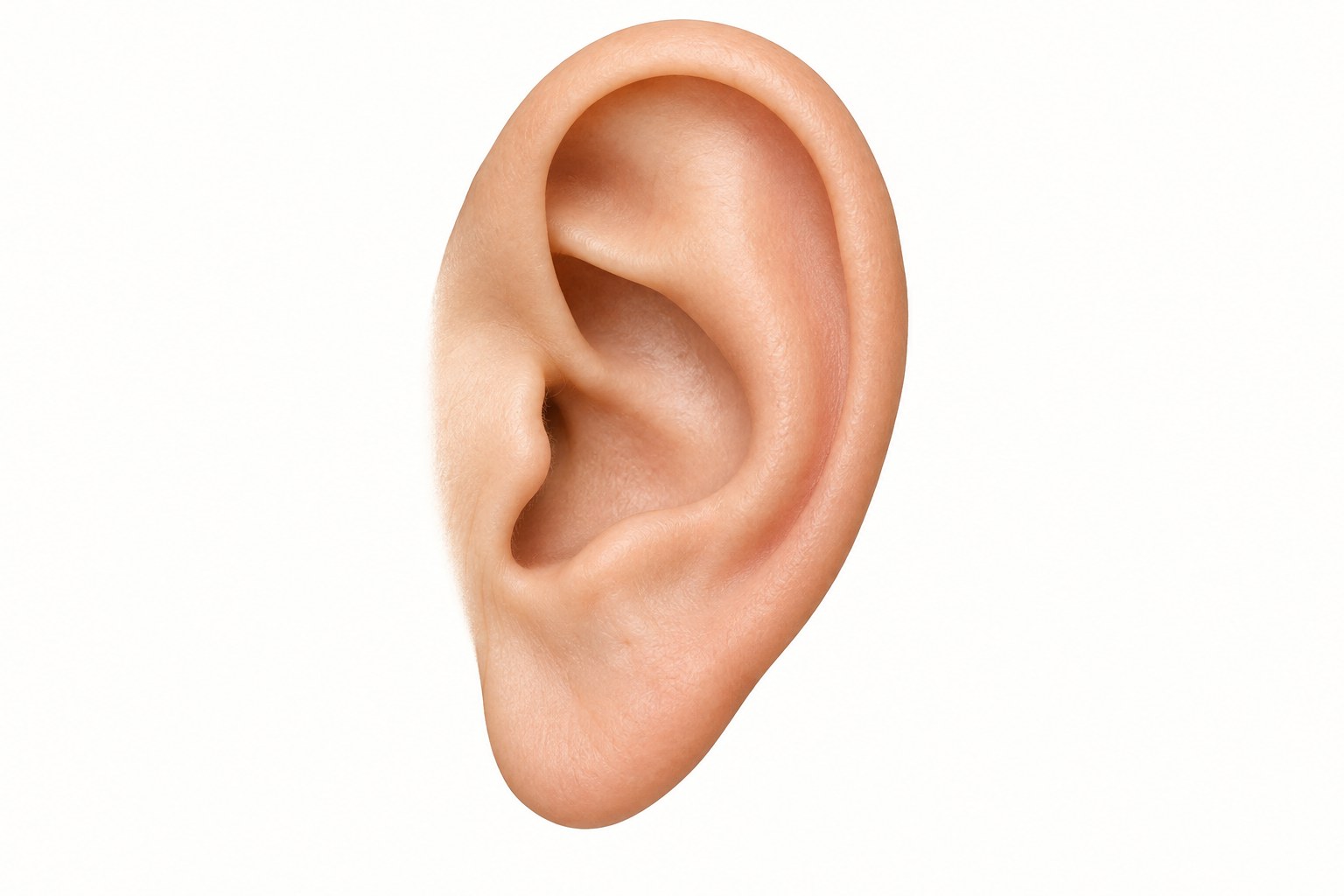
A placement chart for browsing jewelry
| Placement name | Where to look | What to check before choosing jewelry |
|---|---|---|
| Lobe | The soft lower part of the ear | Post fit, backing clearance and the decoration's weight |
| Helix | The outer cartilage rim | Channel angle, post fit and room around the rim |
| Forward helix | The front root of the outer rim | Space for both the front and backing near the ear's attachment |
| Flat | The broad upper cartilage surface inside the rim | The full decoration footprint and rear clearance |
| Conch | The central bowl | Clearance within the bowl; individual diameter fitting if considering a ring |
| Tragus | The small flap beside the ear-canal entrance | Front and rear fit, including contact with earbuds |
| Rook or daith | Different inner cartilage folds | Professional identification and fitting for the specific fold |
This is a location guide, not a list of interchangeable earrings. Our conch piercing guide and flat piercing guide go into more detail about those areas. The names help you ask a clearer question; they don't replace an individual fitting.
Separate the location from the jewelry's shape
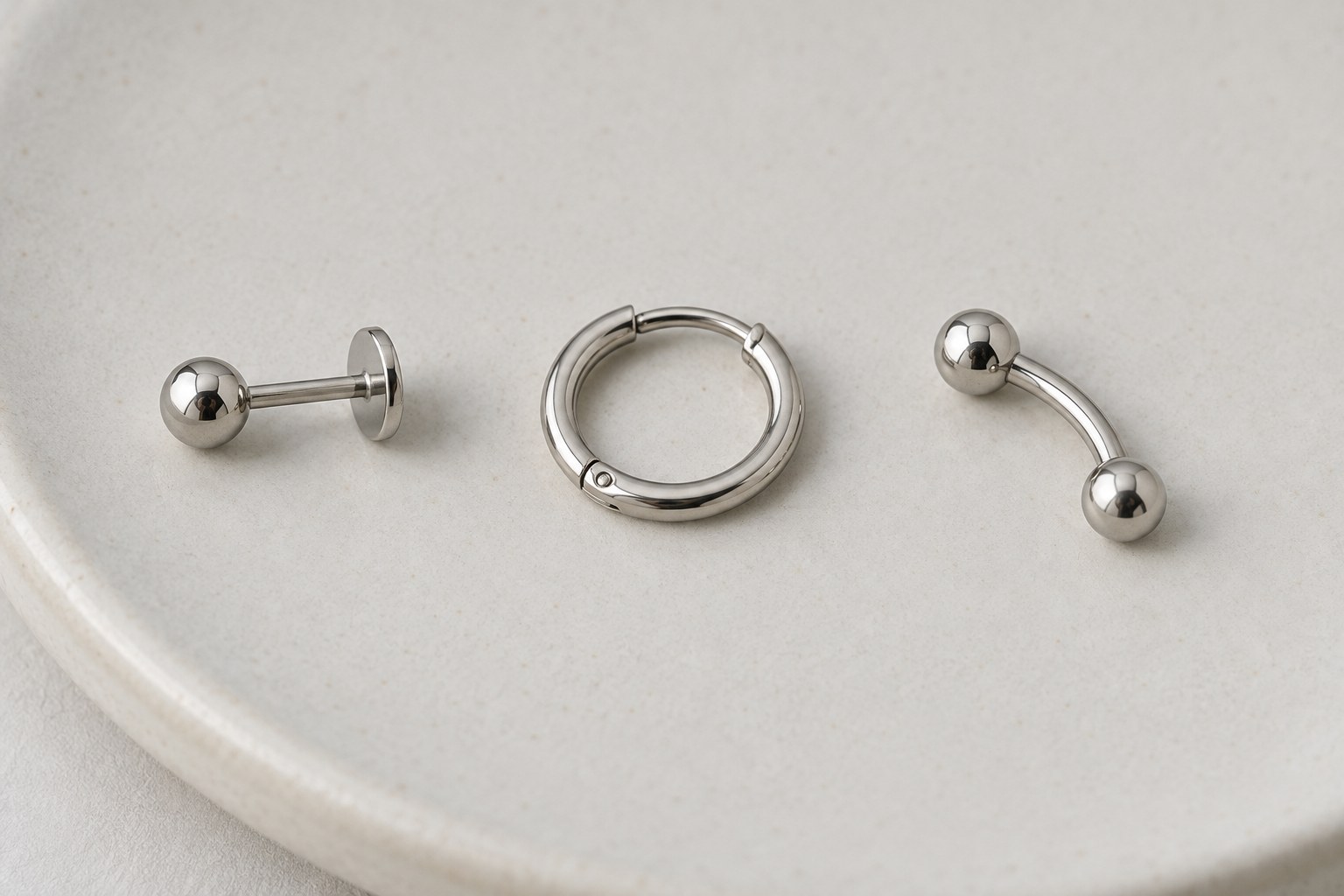
“Helix” tells you where a piercing is. “Stud” or “hoop” tells you about the jewelry. “Flower” or “arc” describes the decoration. A product can carry several of these labels without giving you all the dimensions you need.
For example, a curved decorative arc can attach to a single straight post. Its curved front does not mean it passes through several holes or follows the path of a curved piercing channel. Check a side or back view to see how the piece is built.
Our Graduated Zircon Arc has a nine-stone front and one internally threaded flat-back post per earring. The listing gives a 1.2 mm post diameter and 8 mm post length. It doesn't give the overall width of the arc, so ask for that before deciding whether it has enough room on your ear.
Turn a location into a personal size note
Record the name of your piercing alongside its actual fitting details. For a stud, that includes the post diameter, wearable length, closure and front width and height. For a ring, record the gauge and inner diameter. Add any detail about the backing or a nearby fold that your piercer tells you to account for.
The Petite Crystal Cluster lists a 0.8 mm post diameter, 6 mm wearable length and an approximately 2.6 by 2.3 mm front. Those figures describe one product. They do not establish a standard size for every lobe, helix or flat piercing.
Our Seamless Clicker hoop lists a 1.2 mm gauge and an 8 mm inner diameter. Its 8 mm opening is a different measurement from the Arc's 8 mm post. The earring size guide explains the distinction if you're comparing the two constructions.
Two piercings in the same region can need different fittings. Don't copy a size from an ear chart, a model photo or the other side of your own ear. Ask a piercer to measure unfamiliar fittings, and never force a thicker post through a smaller channel.
Keep material questions on the shopping list
The Association of Professional Piercers' healed-jewelry guidance considers size, material, weight and finish together. A familiar placement name or a flat backing doesn't establish that a piece will suit sensitive skin.
Read the selected item's material and finish description, including the post and back. If you need a specific material standard, request supporting documentation. A G23 label alone does not demonstrate ASTM F136 certification, and gold color does not tell you that an earring is solid gold.
Once you know your fitting, the flat-back earrings category is a useful place to compare fronts and closures. Treat these products as shopping examples for healed piercings. For a new piercing, let a qualified piercer assess your anatomy and select appropriate initial jewelry.
Questions an ear chart cannot answer
Does every ear have room for every placement?
No. A diagram shows named regions, not a promise that a particular piercing can be placed safely on your ear. An in-person assessment is needed before planning a new channel.
Is a double helix one piercing or two?
It describes two separate helix piercings. Each channel needs its own fitting; a shared location name doesn't mean both take the same post length.
Can I use an online photograph to measure my piercing?
A photograph without a reliable scale cannot give you your jewelry size. Perspective also changes how the ear and decoration look. Use measurements from your own correctly fitted jewelry or have a piercer measure the fitting you need.

Related posts

Ear Piercing Costs: What Your Quote Should Include
Compare ear-piercing quotes by the number of holes, complete jewelry, follow-up services and other charges, with specific official studio examples.
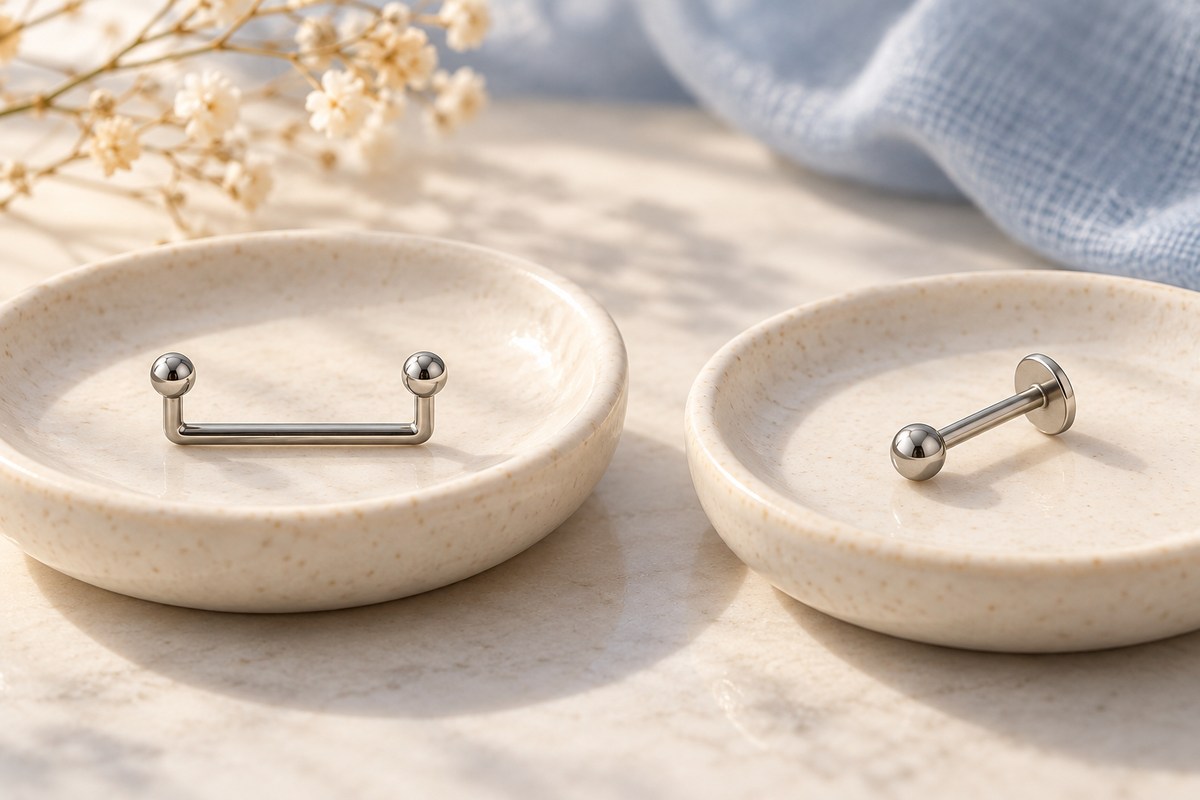
Surface Tragus vs Tragus: Why the Jewelry Is Different
Learn how surface bars, labret studs and surface anchors differ, and what to confirm before buying jewelry for a piercing beside the tragus.
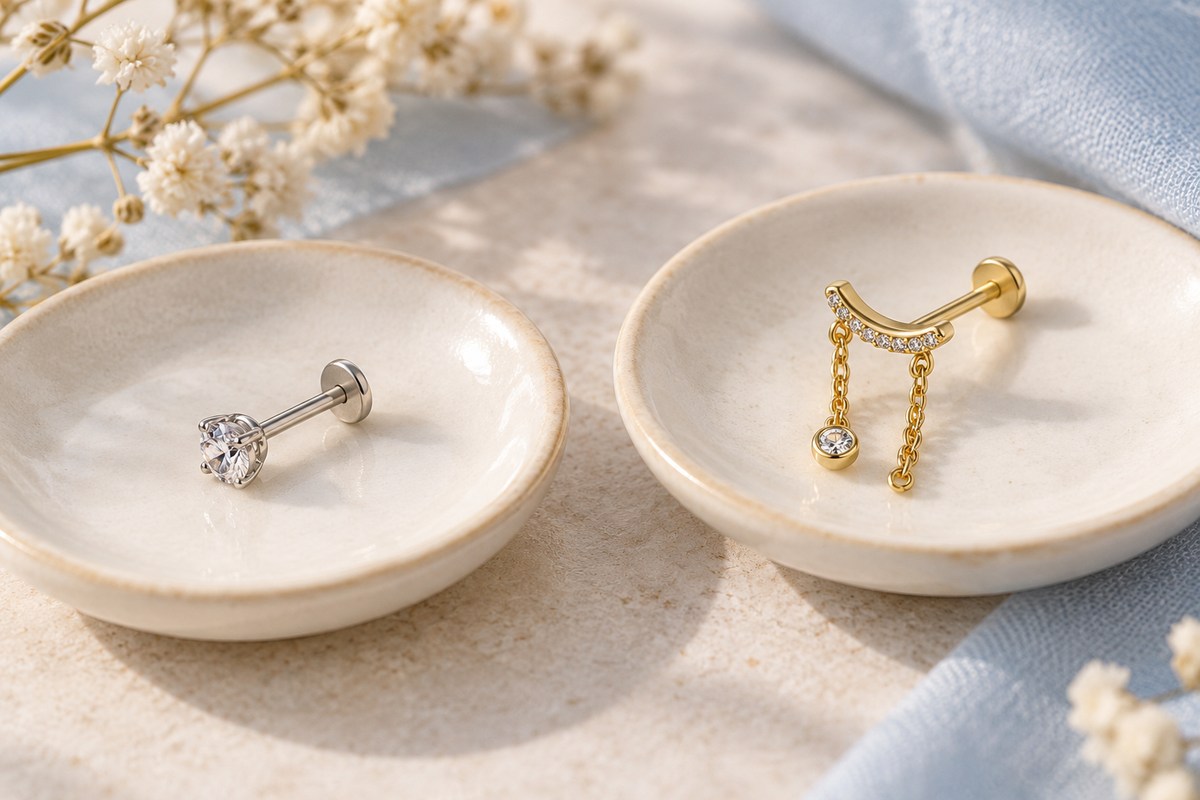
Vertical Helix vs Hidden Helix: Check the Jewelry Direction
Compare vertical and hidden helix descriptions, check what product photographs leave out, and read jewelry specifications for a fully healed piercing.
One thought on “Ear Piercing Placement Chart: Find the Name, Then Check the Jewelry”