

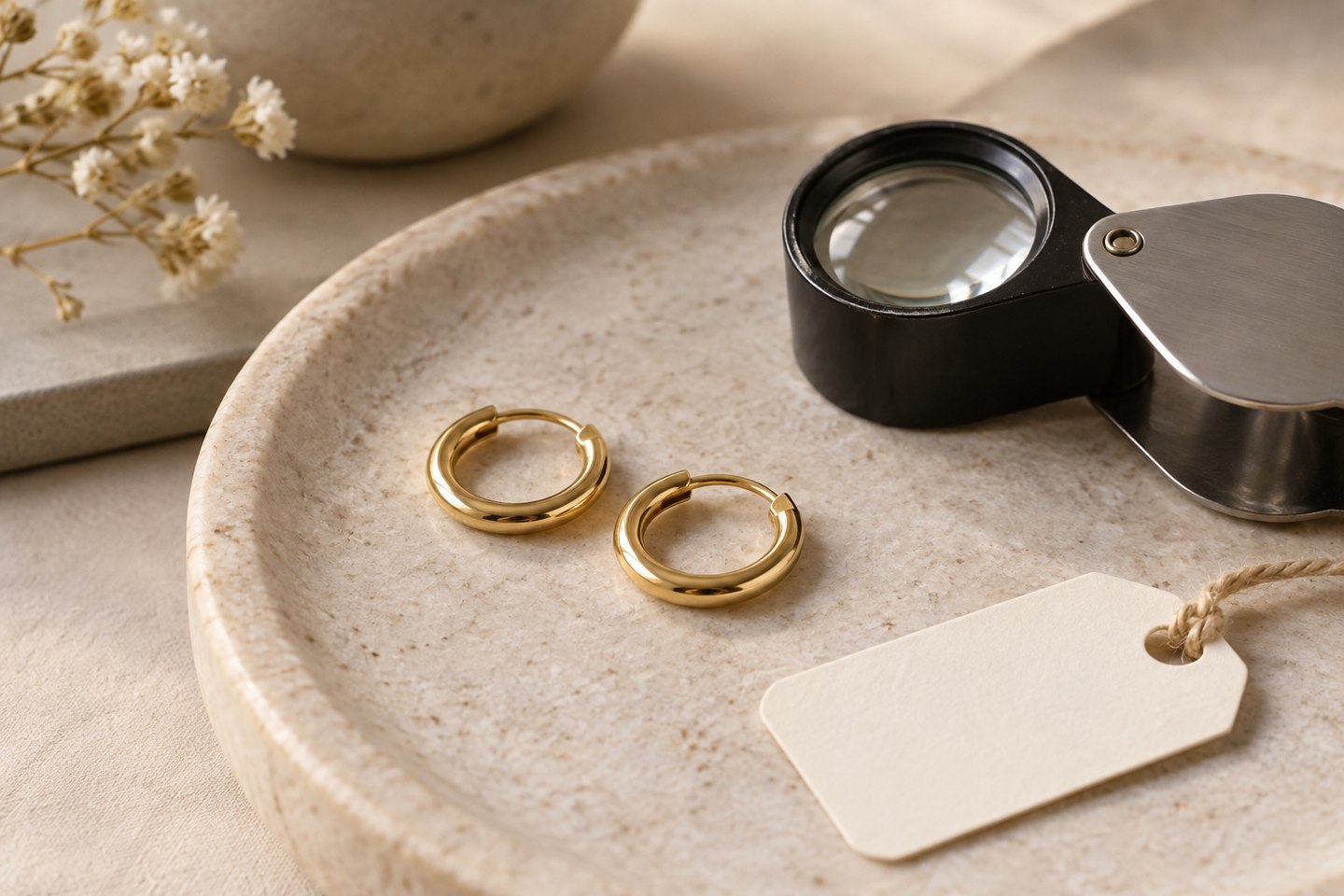
You find a pair of warm gold-colored earrings you like, then notice one word in the description: brass. If earrings have made your ears itchy before, that detail deserves a closer look.
Brass is not enough information to call an earring hypoallergenic. It names a family of metal alloys, not a guarantee about the complete piece or your skin’s response. If you know you have a metal allergy, get those details before buying.
This guide focuses on brass and gold-colored fashion earrings for healed piercings. Choosing jewelry for a fresh piercing is a separate decision to make with a qualified piercer.
What the word brass tells you
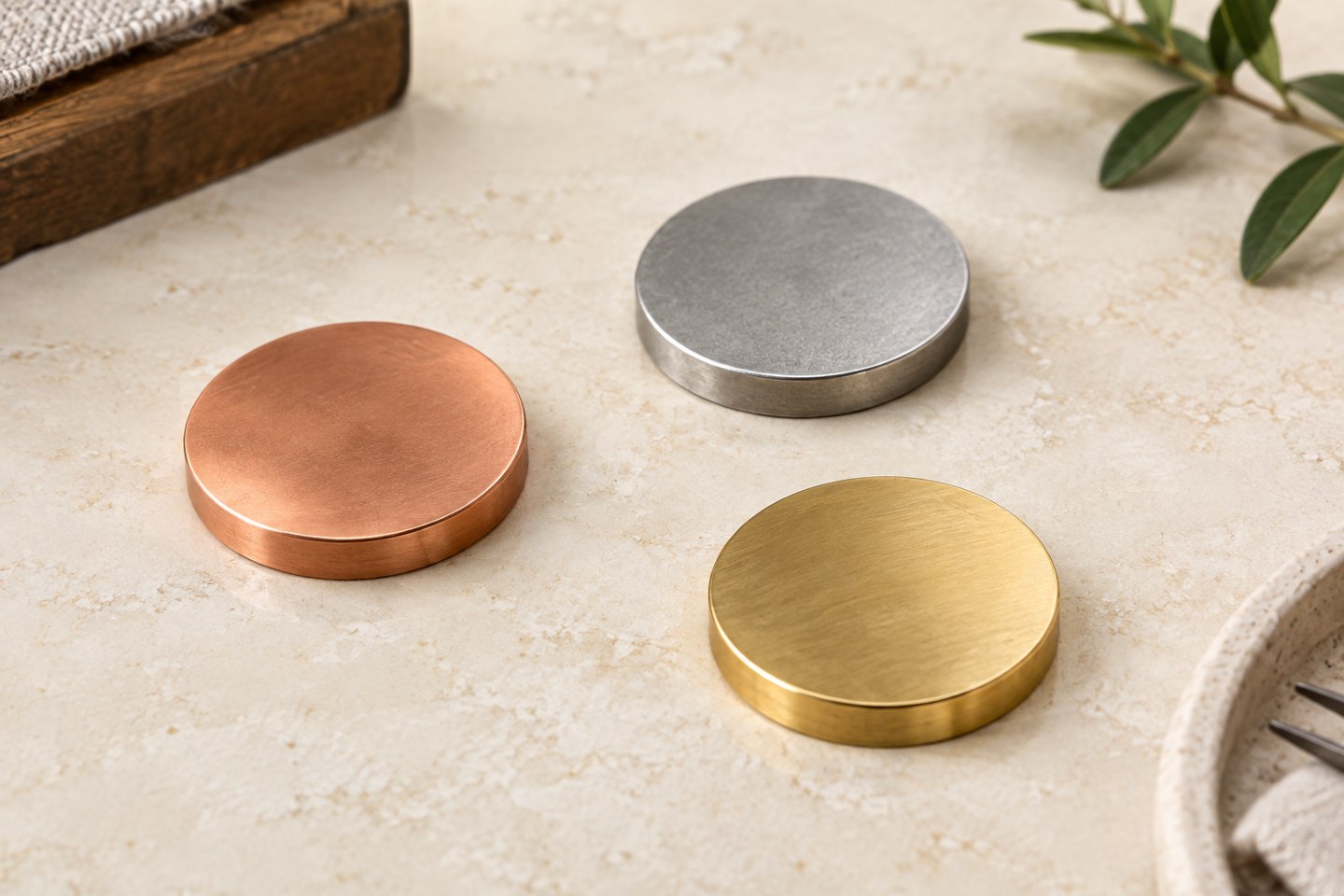
Brass is primarily a mixture of copper and zinc. The Copper Development Association lists a range of brass alloys with different compositions. That means the word on a product page does not give you a full ingredient list for every part of an earring.
It also does not prove that nickel is present, or that it is absent. Avoid both assumptions. If you have a diagnosed allergy, ask the seller for the alloy details and any relevant testing for the finished jewelry. A photograph of a yellow metal cannot answer that question.
An alloy is not automatically unsuitable for sensitive ears simply because it contains more than one metal. The specific composition matters. The Association of Professional Piercers, for example, includes titanium meeting ASTM F136 among its materials for initial piercing jewelry; that is a titanium alloy. Brass and documented F136 titanium should not be treated as equivalent just because both are alloys.
Check three parts of the earring
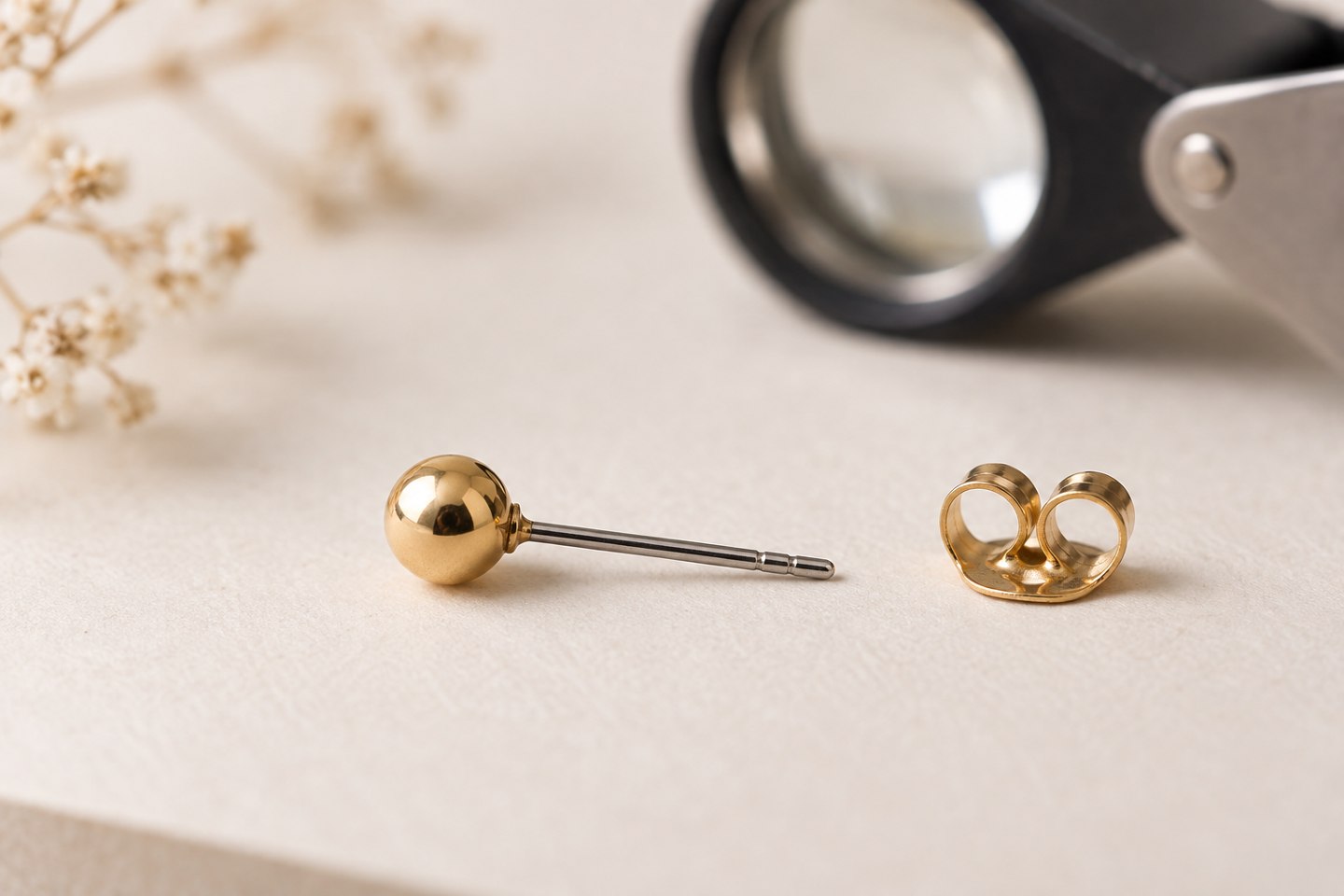
Start with the part that passes through your ear, then work outward. A listing might describe a brass ornament attached to a post made from another metal. You still need information about the backing and any decoration that rests against your skin.
Ask the seller these three questions:
- What metal is the post made from, and is a specific grade identified?
- What are the front and backing made from?
- Is there a coating on any skin-contacting part, and what is underneath it?
Keep the answers tied to the exact item and finish you plan to buy. An explanation about a brand’s titanium collection does not establish the materials of a different pair described as brass.
If the only answer is “hypoallergenic,” follow up with the material question. Our guide to nickel-free and hypoallergenic labels explains why those descriptions should not replace clear specifications.
A gold-colored surface does not settle the question
Gold color and gold content are different pieces of information. Brass can have a yellow appearance without being gold. A gold-plated earring has a surface layer over another material, so the material beneath that layer still matters.
The Federal Trade Commission explains that gold plating eventually wears away, with wear depending on the coating thickness and how the item is used. A coating is not a permanent answer to uncertainty about the metal below it.
There is another useful distinction: the FTC describes vermeil as gold over sterling silver. Do not assume that vermeil means gold over brass, or that every product called “gold” uses the same construction. Ask for clarification when a listing combines conflicting descriptions.
You can still look for a warm-colored pair. Start with a finish you like, then check what you will actually be wearing against your skin.
What a reaction can and cannot tell you
DermNet identifies nickel and cobalt as common causes of jewelry allergy. It also explains that friction, trapped soap and other irritants can produce a reaction around jewelry. Soreness alone does not reveal which metal was used or confirm an allergy.
A pair you wore comfortably in the past is not a permanent test of compatibility. If reactions keep returning, a dermatologist can assess the problem and may use patch testing to identify a contact allergy. Bring the product information you have, including the post and backing materials.
For an established piercing, stop wearing a pair that is causing irritation and seek advice if symptoms persist. A hot, increasingly painful or swollen piercing, pus, or feeling unwell needs prompt medical attention. If infection is suspected, the NHS advises leaving the jewelry in unless a doctor tells you to remove it. Do not repeatedly swap earrings to experiment with a painful piercing.
A practical alternative to an unclear brass listing
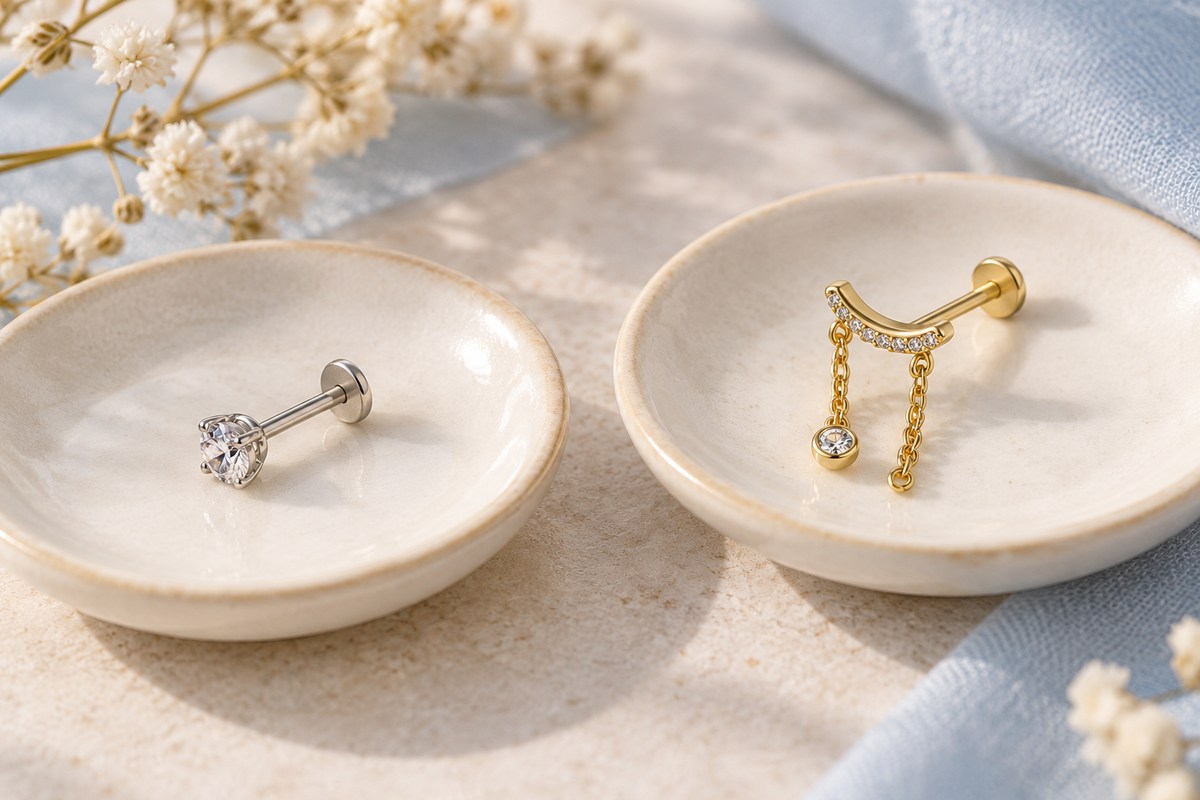
For healed ears, it helps to compare specific designs and their listed materials. Our Crystal Flower flat back studs are listed as F136 titanium, with an internally threaded closure and an approximately 3.1 mm decorative front. The Petite Crystal Cluster studs are listed as F136 titanium with a push-pin closure and an approximately 2.6 by 2.3 mm front.
Those measurements describe the decoration, not the post thickness or length. Check the selected variant’s full dimensions against your piercing before ordering. If you are unsure, take the specifications to your piercer.
Both listings offer a Gold color option as well as Natural Titanium. A color name by itself does not tell you the surface process or make a promise about allergy risk. Ask about the finish if that information affects your decision. These are examples to compare by specification, not a treatment for irritated ears or a substitute for a professional fitting.

Questions shoppers ask about brass earrings
Does all brass contain nickel?
No such conclusion follows from the name alone. Brass identifies copper-zinc alloys; it does not provide a complete specification for an assembled earring. Ask about the actual alloy, post, backing and coatings rather than assuming that every brass item has the same composition.
Can I put brass earrings in a new piercing?
Do not use an ordinary fashion-jewelry listing to choose starter jewelry. Ask a qualified piercer to select appropriately sized jewelry with suitable material documentation and surface quality. Our starter-jewelry guide explains the checks involved.
Should I choose the gold or silver-colored version?
Choose the appearance you like after checking the materials and finish of that version. Two colors on the same product page may need different care information. Neither color establishes whether the jewelry suits a known allergy.

Related posts

Ear Piercing Costs: What Your Quote Should Include
Compare ear-piercing quotes by the number of holes, complete jewelry, follow-up services and other charges, with specific official studio examples.
Surface Tragus vs Tragus: Why the Jewelry Is Different
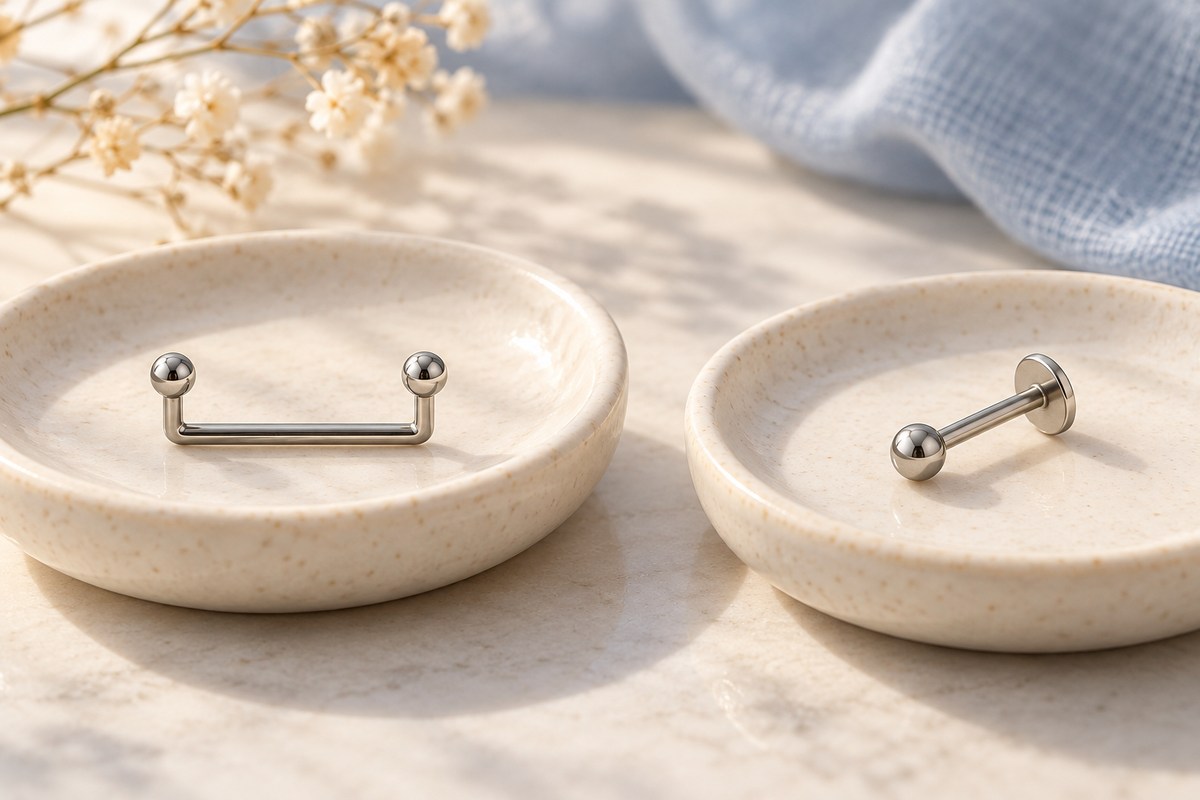
Learn how surface bars, labret studs and surface anchors differ, and what to confirm before buying jewelry for a piercing beside the tragus.
Vertical Helix vs Hidden Helix: Check the Jewelry Direction
Compare vertical and hidden helix descriptions, check what product photographs leave out, and read jewelry specifications for a fully healed piercing.