

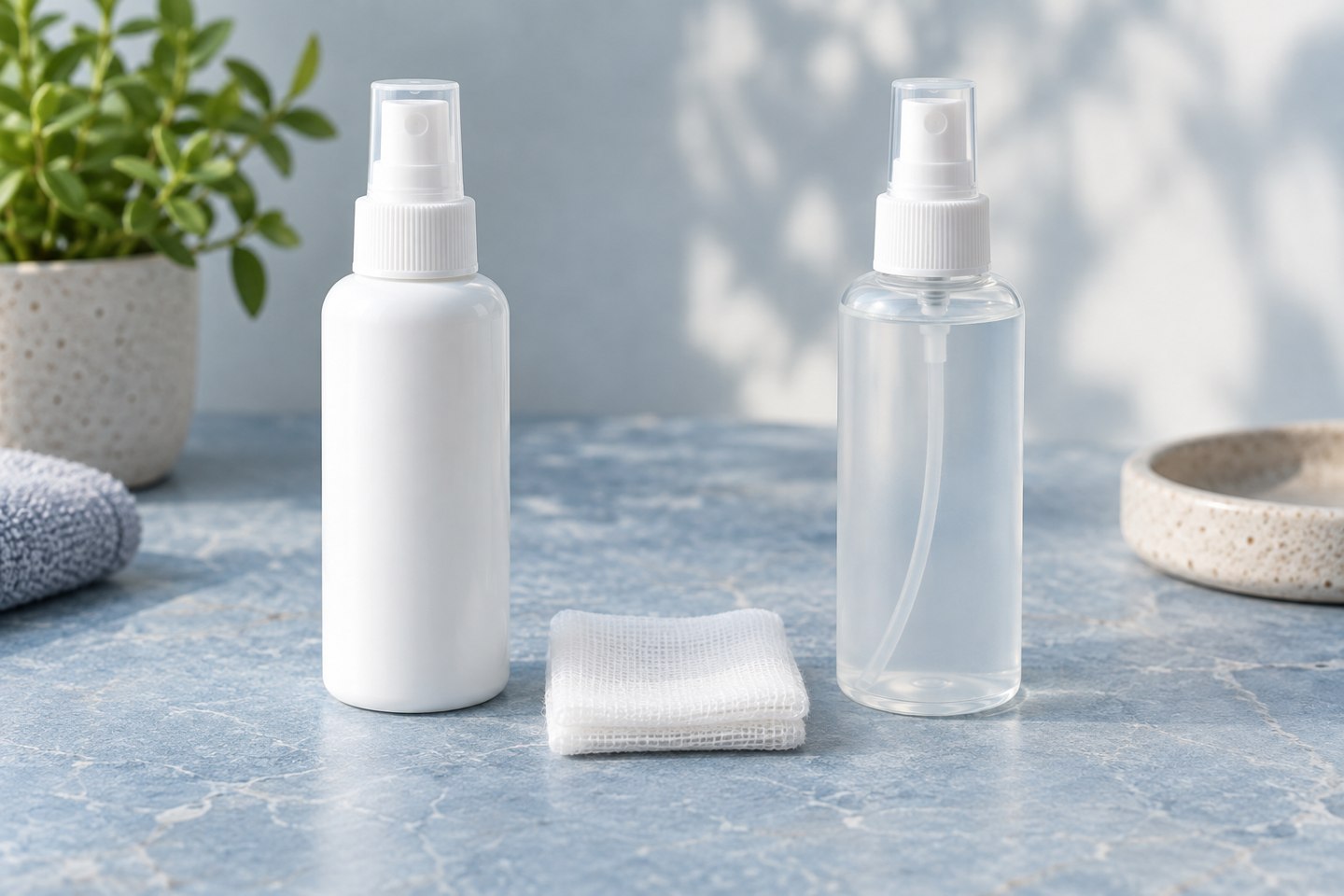
You already have a bottle of saline, but keep seeing hypochlorous acid sprays recommended online. Before buying one for your new ear piercing, check whether there is a reason to change the care plan you were given.
Start with the plan your piercer gave you. The Association of Professional Piercers recommends sterile saline wound wash for healing piercings. General information about hypochlorous acid in skin care does not establish that changing products will improve your ear piercing. Before buying another bottle, check what you have, what the proposed replacement is intended for, and why you want to switch.
Read the ingredients before comparing the promises
Saline wound wash and an HOCl product are different formulations. For routine piercing care, the APP specifies sterile wound wash containing 0.9% sodium chloride, with water sometimes listed, and no added moisturizers or antibacterial ingredients. It advises against homemade salt mixtures and substituting contact lens solution, nasal spray, or eye drops.
Hypochlorous acid, often shortened to HOCl, is a compound the body produces as part of its immune response. Cleveland Clinic explains that manufacturers also use it in skin care, wound-care products, and household cleaners. Those products have different intended uses and cannot be treated as interchangeable.
Put the two labels side by side. Find the full ingredient list, intended use, and directions. A product photograph showing a spray nozzle tells you very little about what is inside. If a description only says “gentle” or “advanced,” look for the details elsewhere on the packaging or ask the manufacturer.
Ask what the evidence actually covers
Cleveland Clinic discusses HOCl’s antimicrobial activity and uses in general skin and wound care. Its article does not compare HOCl with sterile saline for ear piercings or establish a faster piercing-healing schedule.
That distinction matters when a claim moves from a skin-care article into a piercing advertisement. “Used in wound care” and “shown to be better for this piercing” are different claims. Ask whether the recommendation concerns the exact bottle being sold and your intended use.
You don’t need to assess a research paper alone. Bring the product page or packaging to your piercer and ask why they recommend it for your situation. If a clinician has prescribed a care plan, discuss any proposed change with them. Keep the answer with your existing instructions so you know which advice you are following.

Be specific about why you want to change
Perhaps your usual saline is out of stock. Perhaps the skin feels uncomfortable, or someone has said a different spray worked for them. These are useful starting points for a conversation, but they do not all call for the same response.
For a stock problem, ask your piercer how to identify a suitable replacement from the labels available. For discomfort, describe where it is, when it started, and what has changed. Mention the current product and how often you use it. A short note is easier to discuss than a list of products you have already tried.
The APP warns against overcleaning and rotating jewelry, and recommends professional jewelry changes during healing. Ask how a proposed product would fit into your existing routine before adding another cleaning session.
Include the jewelry in the conversation
The bottle is only one detail worth checking. APP jewelry guidance explains that size, shape, material, and surface quality affect a fresh piercing. Jewelry that fits too tightly or catches because it is too large can cause problems.
Tell your piercer if the post catches on your hair, if a backing feels tight, or if you have noticed a change in how it sits. Our guide to piercing post downsizing explains the questions to bring to a fit review. Let the person assessing the piercing decide whether the jewelry needs attention.
For future shopping after healing, keep a record of the size and fastening your piercer recommends. For example, the Crystal Flower flat-back stud lists F136 titanium and an internally threaded fastening. Those are specifications to compare with your requirements when choosing jewelry for a healed piercing. Check the available post size and the material details for the contact parts before ordering; the flower design alone cannot tell you how it will fit.
Our comparison of push-pin and threaded flat backs can help you understand fastening terms before you shop. Use it to prepare questions about compatibility; it does not establish that a particular piece is suitable for a healing piercing.
Know when to seek medical help
A spray comparison should not delay care if you think the piercing may be infected. The NHS advises urgent medical help for a suspected piercing infection. Warning signs include heat, swelling, pain, marked redness or darkening, blood or pus, or feeling feverish, shivery, or generally unwell. Leave the jewelry in unless a doctor tells you to remove it.
Tell the healthcare professional when the symptoms began and which products you have used. Bring the packaging if you can. You don’t need to identify the cause before asking for help.

Leave with one clear plan
Before changing products, ask your piercer or clinician to confirm the exact product, how to use it, and when to contact them again. Read back anything that conflicts with your earlier instructions. Keep the packaging and the written plan together.
If your only reason for switching is an advertisement, there is no need to rush the purchase. Check the claim against the product label and the advice for your piercing first. Keep the agreed instructions where you can find them, along with the studio or clinic contact details.

Related posts

Ear Piercing Costs: What Your Quote Should Include
Compare ear-piercing quotes by the number of holes, complete jewelry, follow-up services and other charges, with specific official studio examples.
Surface Tragus vs Tragus: Why the Jewelry Is Different
Learn how surface bars, labret studs and surface anchors differ, and what to confirm before buying jewelry for a piercing beside the tragus.
Vertical Helix vs Hidden Helix: Check the Jewelry Direction
Compare vertical and hidden helix descriptions, check what product photographs leave out, and read jewelry specifications for a fully healed piercing.